Tuesday, October 19, 2010

For Thursday (10/21)


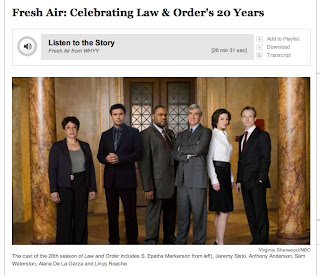
First, make sure that you've finished up your Proppian analysis of your second Law and Order episode. You'll collaborate on the wiki page, e.g. you and your comrades should work together via the wiki page to elaborate the episode's sequence of narrative functions, dramatis personnae, oppositions, and plot summary.

Second, read both the Saussure piece and Daniel Chandler's Semiotics for Beginners.  We'll discuss these two pieces in class.

Monday, October 18, 2010

For Tuesday (October 18)


By now you should have completed the following for at least one episode of Law and Order: on the wiki page for that episode, you and your comrades should have created a plot summary, a quick outline of dramatis personnae and oppositions, and a "Proppian" sequence of narrative functions. Your page should be organized with the sequence of narrative functions at the top, separated by a horizontal line from the section on dramatis personnae and oppositions, separated by a horizontal line from the plot summary.

(It might also be helpful to insert a table of contents into your wiki page. To do this: first, highlight each section heading (narrative sequence, dramatis personnae/oppositions, plot summery) and under the "Format" menu click on "Heading." This will turn each section title into a heading. Next, go to the "Insert" menu and click on "Table of Contents." If you've properly formatted each section title as a "Heading" - - a table of contents box will appear on your page. You can position this box wherever you like - - typically the upper-right hand corner of the page. When you mouse over or click the box, a small menu bar appears below it. It's often helpful to turn "On" the text wrap function so that page text flows around your table of contents.)

Monday, October 11, 2010

For Tuesday (October 12)


Be sure to download the first episode of Law & Order, Season 1 - Law & Order and two other episodes of your choice. Check the class wiki before you download your two episodes.

Watch "Prescription for Death" and do a plot summary. (You might also find it helpful to look at the "narrative grammar" of the Western, as outlined by Will Wright.)

Also, don't forget our extra credit assignment on Raymond Carver.

Friday, October 1, 2010

For Tuesday (October 5)


We'll be reading Hawthorne's short story, "Young Goodman Brown." As you read the story, try to create a plot summary. We'll see if we can match Hawthorne's narrative "grammar" with the fairy-tale grammar outlined by Propp.

Also, you should begin browsing through Law & Order, Season 1 - Law & Order on iTunes to select the two episodes you want to analyze. (You might as well download the first episode - - Law & Order, Season 1 - Law & Order - - as we'll be talking about this episode together in class.) Once you've selected a couple of episodes, be sure to sign up for them on our class wiki.

Wednesday, September 29, 2010

For Thursday (September 30)


Your goal for Thursday is to do a "Proppian" analysis of the Russian fairy tale that I distributed in class.

First, read through the fairy tale. Next, consult the list of Propp's 31 narrative functions. (If you're a little fuzzy about what they mean - - try checking our class notes.) Now return to the fairy tale.

List the Proppian functions you can find in the fairy tale. Use a numbered list with the title of the function, eg. "1. Absententation: the father goes off somewhere," etc.

You should come to class with a list of functions discovered in the fairy tale.

Tuesday, September 21, 2010

For Thursday (September 23)


Phase II of the Carver project, which means:

1) move your individual discussion questions to a separate page ("under" the main story page) and put your three group discussion questions on your main story page;

2) choose at least two stories (besides your own) from our list ("The Bath," "Mr. Coffee and Mr. Fixit," "So Much Water So Close to Home," "A Serious Talk," "Popular Mechanics," "I Could See the Smallest Things," or "Tell the Women We’re Going") and read them;

3) go to the story page for your two stories and answer the discussion questions (n.b. try to keep track of how many people have answered the discussion questions - - if eight of your comrades have already answered the questions, move on to another set) in a paragraph of two for each one;

4) come to class on Thursday prepared to discuss the stories.

Tuesday, September 14, 2010

For Thursday (Sept. 16)


For Thursday, we'll read Ray Carver's short story, "What We Talk about When We Talk about Love."

Also, be sure to choose your story from the Carver collection - - the story that you want to own. You should choose from one of the following stories: "The Bath," "Mr. Coffee and Mr. Fixit," "So Much Water So Close to Home," "A Serious Talk," "Popular Mechanics," "I Could See the Smallest Things," or "Tell the Women We’re Going."

Finally, since some of you have indicated some confusion about what your Joyce annotations should look like, I've added an example to the Joyce assignment page.